Car Maintenance Tips

Mason O'Donnell
| 13-04-2026
 · Automobile team
The breakdown almost never announces itself in advance.
One morning the car starts fine, the commute is unremarkable, and everything feels normal.
Then something gives way — a belt, a tire, an overheating engine — and what began as an ordinary Tuesday becomes an expensive, stressful event on the side of a highway.
In almost every case, the problem had been developing for weeks or months, detectable by anyone who knew where to look. The breakdown was not sudden. The attention was.
Car maintenance is one of those areas where the return on a small, consistent investment is disproportionately large. The checks that prevent the most expensive failures cost almost nothing to perform regularly — and the failures they prevent can cost thousands of dollars and considerable inconvenience to repair.
Engine Oil — The Most Critical Fluid in the Vehicle
Engine oil lubricates the hundreds of moving metal components inside the engine, reducing friction and preventing the kind of heat buildup that causes permanent damage.
When oil levels drop too low, or when oil degrades past its useful life without being changed, metal components begin making direct contact with each other under extreme heat and pressure. The resulting damage — scored cylinder walls, worn bearings, seized components — is among the most expensive repair categories in automotive maintenance.
Checking the oil level takes less than two minutes and should be done monthly on most vehicles. With the engine off and the car parked on level ground, locate the dipstick, wipe it clean, reinsert it fully, and withdraw it again. The oil level should sit between the two marks on the dipstick. If it is below the lower mark, add the grade specified in the owner's manual before driving further.
Oil change intervals have extended significantly as oil technology has improved. Many modern vehicles with synthetic oil can go 7,500 to 10,000 miles between changes. Follow the manufacturer's specification in the owner's manual rather than the older conventional wisdom of every 3,000 miles, which is no longer accurate for most current vehicles.
Tire Pressure and Tread Depth
Tires are the only part of the vehicle in contact with the road, and their condition affects braking distance, handling precision, and fuel efficiency simultaneously. Both underinflation and overinflation degrade performance and accelerate wear — yet tire pressure is among the most commonly neglected checks on any vehicle.
Correct tire pressure for a specific vehicle is found on a sticker inside the driver's door jamb — not on the tire sidewall, which shows the maximum pressure the tire can hold rather than the recommended operating pressure. Check pressure monthly with a quality gauge when the tires are cold, before the car has been driven.
Tread depth determines how effectively the tire channels water away from the contact patch on wet roads. The legal minimum in most jurisdictions is 2/32 of an inch, but braking performance begins degrading measurably before that point.
The penny test provides a quick field assessment — insert a penny into the tread groove with the top of the figure facing down. If the top of the figure is visible, the tread is at or below the minimum, and the tire requires replacement.
Coolant Level and Cooling System Health
The cooling system prevents the engine from reaching temperatures that cause permanent damage. Coolant circulates through the engine block, absorbs heat, passes through the radiator to release that heat, and returns to repeat the cycle. When the coolant level drops or the system develops a leak, the engine temperature rises beyond safe operating limits.
An overheated engine can warp cylinder heads, damage head gaskets, and in severe cases cause catastrophic internal failure — repairs that routinely exceed the value of older vehicles. The coolant reservoir is a translucent plastic tank in the engine bay with minimum and maximum markings on the side. The level should be checked monthly when the engine is cold. Never open the radiator cap on a hot engine.
Coolant itself degrades over time and should be flushed and replaced according to the manufacturer's schedule — typically every two to five years, depending on the type of coolant used.
Brake System Inspection
The braking system is the most safety-critical mechanical system on the vehicle, and its condition directly determines the stopping distance in emergencies. Brake pads wear gradually and provide an audible warning when they reach a critical thickness — a high-pitched squealing sound that occurs during normal braking indicates the wear indicators are contacting the rotor and replacement is needed.
Ignoring this warning and continuing to drive on worn pads leads to metal-on-metal contact between the caliper and rotor. This damages the rotor — a component that costs significantly more to replace than pads alone — and compromises braking effectiveness in ways that become dangerous rather than simply expensive.
Brake fluid should also be checked periodically. Brake fluid absorbs moisture over time, which lowers its boiling point and can cause brake fade under hard use. Most manufacturers recommend replacing brake fluid every two years, regardless of mileage.
Drive Belts and Battery Condition
Two components that fail without gradual warning deserve regular attention precisely because they provide so little advance notice.
The serpentine belt drives the alternator, power steering pump, air conditioning compressor, and other accessories from the engine's rotation. When it fails, it fails completely and immediately — leaving the vehicle without charging, steering assistance, and other functions simultaneously.
Visual inspection of the belt for cracking, fraying, or glazing on the inner surface should be part of any routine service. Most manufacturers recommend replacement between 60,000 and 100,000 miles.
The battery provides the electrical current required to start the engine and powers the vehicle's electronics when the engine is off. Most batteries last between three and five years.
A battery that is approaching the end of its service life may start the vehicle normally in mild weather and fail completely in cold conditions, because cold temperatures reduce battery output significantly. Many auto parts retailers offer free battery testing, which measures remaining capacity and provides advance warning before a failure strands the vehicle.
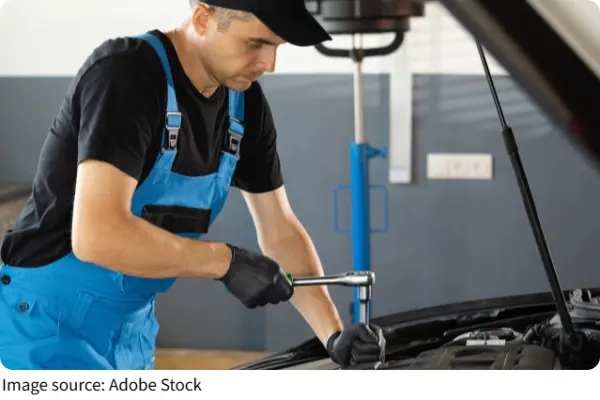
None of these checks require mechanical expertise or specialized tools. They require familiarity — knowing where to look, what normal looks like, and what deviation from normal means.
A vehicle that receives consistent attention at these five points will cost considerably less to own over its lifetime than one that receives attention only when something goes wrong. The difference between those two outcomes is almost always a matter of habit rather than knowledge.